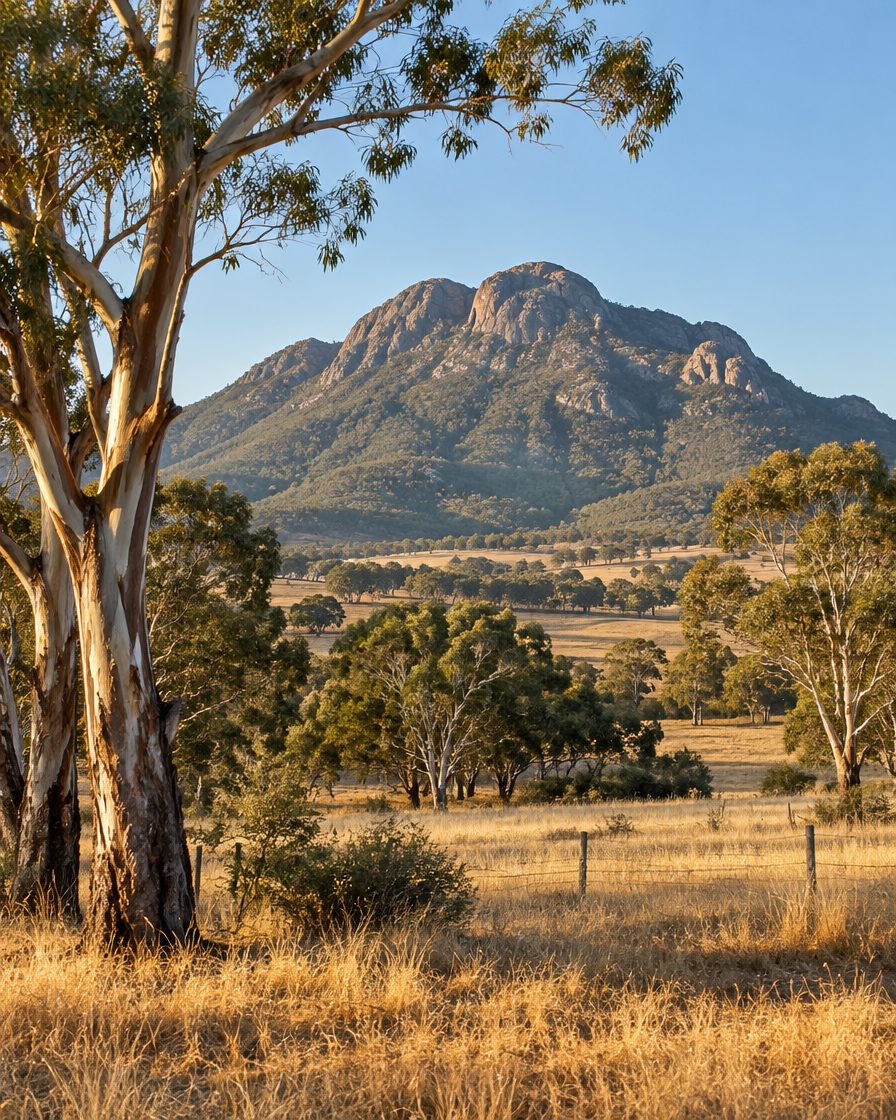
Langi Ghiran's granite peak rising above woodland and golden grassland

Home / Our story / A deep history

350 million years in the making. A future for everyone.

The granite under Langi Ghiran is older than the dinosaurs. People have cared for this Country for tens of thousands of years. This is the long story of the land we're restoring, and where it goes next.

350 millionYears since the granite of the region formed deep underground
22,000+ yearsOf Djab Wurrung and Jardwadjali connection to the ranges of this region
Since 1993Our family's connection to country.
NextThree downhill runs, a kids’ jump park and a pulley lift back to the top
01Deep time

Before there was a mountain, there was molten rock.

The granite of this part of western Victoria formed around 350 million years ago, when magma cooled slowly two to five kilometres below the surface. That's more than 100 million years before the first dinosaurs.

For most of that time, the granite stayed buried. Over roughly the last 15 million years, erosion stripped away the rock above it and exposed the hard core we now see as Langi Ghiran's peaks. Weathering did the rest, breaking the granite into rounded tors and boulders, sandy gravels and clays.

Geologists use Langi Ghiran as the reference example for how groundwater moves through fractured granite across this part of western Victoria.
The long view

From magma to mountain bikes.

A very short history of a very old place.

  1. 350million years ago

    Granite forms

    Magma cools slowly two to five kilometres underground, creating the granite of the region.

  2. 15million years to now

    The mountain emerges

    Erosion removes the rock above and exposes the granite. Weathering shapes tors, boulders, sands and clays.

  3. 22,000+years

    Country

    Djab Wurrung and Jardwadjali peoples' connection to the ranges of this region stretches back more than 22,000 years. Evidence elsewhere in western Victoria shows people were here at least 34,000 years ago.

  4. 1836

    Mitchell's expedition

    Surveyor Thomas Mitchell becomes the first European to climb the mountain, naming it Mount Mistake.

  5. 1880

    The granite reservoir

    A reservoir and stone water races are built from local granite to supply water to Ararat. They're still there today.

  6. Later

    Sand extraction

    The property beside the park's western boundary is worked as a sand mine and quarry by the City of Ararat, changing the original landform.

  7. 1993

    Recycle Group arrives

    Recycle Group's connection with the property begins, and grows over three decades.

  8. Today

    Recycling and rehabilitation

    Suitable soil is recycled to rebuild the land disturbed by extraction.

  9. Next

    A place for the community

    Beginner, intermediate and expert downhill runs and a kids’ jump park on restored land, with a pulley lift to take riders back up the hill.

02Country and art

Lar-ne-jeering: Home of the Yellow-tailed Black Cockatoos.

Long before Mitchell's expedition, this was Country. Langi Ghiran is the anglicised form of Lar-ne-jeering, the mountain's name in the language of the Djab Wurrung people. Parks Victoria recognises its cultural and spiritual significance to the Djab Wurrung people, and the park as part of the Aboriginal cultural landscape of the Eastern Maar Peoples.

This corner of Victoria holds one of the richest bodies of Aboriginal rock art in the country. Gariwerd, the ranges just to the west, has the highest concentration of rock art in south-east Australia, with hundreds of sites across the mountains. Djab Wurrung and Jardwadjali Country holds the great majority of Victoria's known Aboriginal rock art.

Langi Ghiran has its own. On the Lar-ne-jeering walk, a rock art site and rock shelter sit among the granite boulders. The paintings are faded now and protected from damage. Parks Victoria describes them as a testament to a long history and an enduring connection to Country.

The stories behind the art belong to the Traditional Owners, and it isn't our place to tell them. What we can do is look after our part of the landscape with respect, and encourage visitors to treat these places the same way.

LG Recycling acknowledges the Traditional Owners of Lar-ne-jeering and respects their enduring connection to this Country.

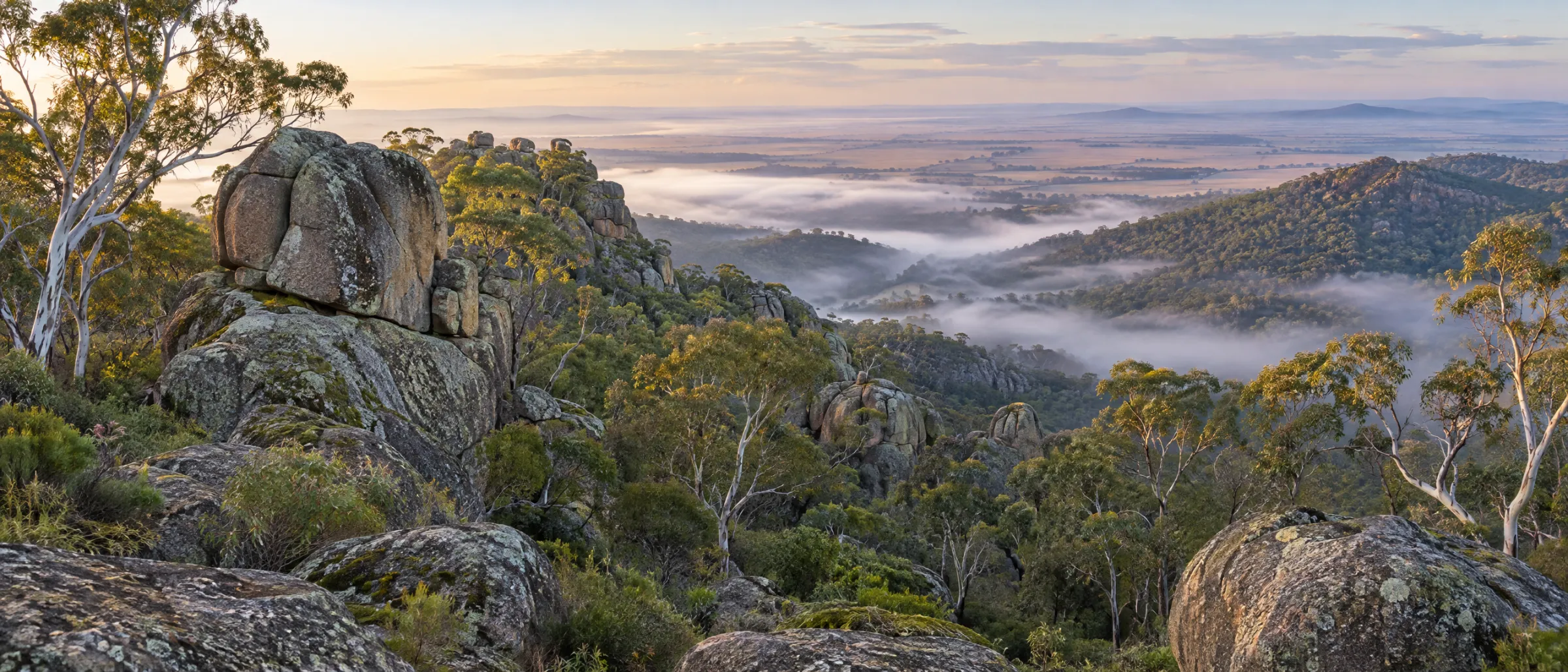
Granite tors and eucalypt woodland on the slopes of Langi Ghiran, with mist in the valley below

Extraction was one chapter. Natural beauty is the next.

03Returning the land

Giving back what was taken, one load at a time.

Sand extraction changed the original landform and left areas of disturbed ground. The landscape next door shows what this country can be: granite peaks, open woodland, River Red Gums and Yellow Box, and wildlife from kangaroos and echidnas to Wedge-tailed Eagles.

Every suitable load of soil that arrives at LG Recycling helps rebuild the landform: reshaping slopes and restoring levels so the ground can hold vegetation again. As each area is finished, the aim is native vegetation that belongs here, taking its cue from the woodland across the boundary.

Landforms rebuilt.

Native vegetation returned.

Habitat for the wildlife of the ranges.

A landscape that sits comfortably beside the park again.

Revegetation species and staging will be published once the rehabilitation plan is confirmed.

04For the community

A former quarry people can ride, walk and enjoy.

Rehabilitation isn't only about how the land looks. It's about who gets to use it. The restored land is being turned into a downhill mountain-bike park: three runs graded beginner, intermediate and expert, a kids’ jump park at the bottom for younger riders, and a pulley lift to take riders back up the hill, so they can spend their time riding rather than pushing. Off to the side, 16 glamping sites will let visitors stay the night.

Around the track, the vision is open space for families, walkers and visitors, sitting alongside one of western Victoria's most distinctive natural landscapes and the walks of Langi Ghiran State Park next door. It would also give visitors to the Grampians region another reason to stop and stay.

It's a simple idea: the soil that helps rebuild the land also helps build something the whole community can enjoy, for generations.

The bike park is coming in 2030. Track layout and access arrangements are still being planned.

 Sources

Geology: Visualising Victoria's Groundwater: Local flow systems in fractured granitic rocks (Mt Langi Ghiran type area). Country, rock art, reservoir and natural values: Parks Victoria: Langi Ghiran State Park. Gariwerd rock art and the 22,000-year connection: First Peoples – State Relations Victoria: Gariwerd. Share of Victoria's rock art on Djab Wurrung and Jardwadjali Country: Wikipedia: Djab Wurrung. 34,000-year evidence in western Victoria: University of Melbourne, Pursuit (2020). Mitchell, Mount Mistake and the reservoir: Wikipedia: Langi Ghiran State Park.

Got suitable soil?

Every load helps rebuild the land.